
The Privacy Pivot: Proton Sheets Challenges Big Tech’s Grip on Productivity
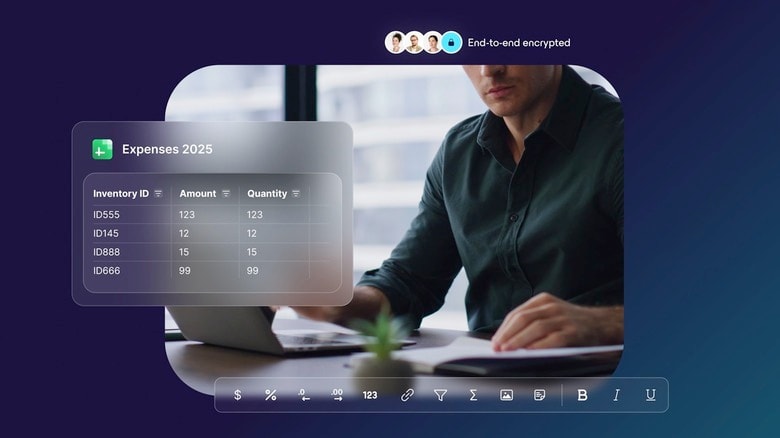
Proton finally closed the loop on its ecosystem Thursday. With the launch of Proton Sheets, the Swiss software company has delivered the last critical piece of its puzzle, offering a fully end-to-end encrypted rival to Microsoft Excel and Google Sheets. For years, the choice was binary: use convenient, data-hungry tools from Silicon Valley or struggle with offline, fragmented privacy solutions. Proton Sheets attempts to break that dichotomy, integrating a live spreadsheet editor directly into Proton Drive. The result is a productivity suite where the "zero-knowledge" architecture protects not just the file storage, but the active data entry itself.
A New Standard for Data Sovereignty
The killer feature of Proton Sheets isn't a new formula or a slick UI—it’s the plumbing underneath. Unlike Google Drive or Microsoft OneDrive, which retain the technical ability to scan user data for targeted ads or, increasingly, to train Large Language Models (LLMs), Proton Sheets is built on default end-to-end encryption (E2EE).
The difference is simple: Google and Microsoft hold the decryption keys to your data; Proton does not. In Proton’s architecture, encryption happens client-side—meaning your financial projections or client lists are scrambled into gibberish before they ever leave your laptop. Consequently, not even Proton’s own engineers can access the contents of your spreadsheets. This protection is granular, extending to metadata; file names, thumbnail previews, and extensions remain invisible to the server.
For high-stakes fields—legal defense, healthcare, or investigative journalism—this creates a compliance-ready environment shielded by strict Swiss privacy laws, distinct from US and EU jurisdiction. But even for the average user, the threat model has shifted. It is no longer just about preventing data breaches; it is about opting out of the surveillance economy and ensuring your intellectual property isn't being quietly scraped to make an AI smarter.
Functionality and User Experience
Privacy tools often die on the hill of poor usability, but at first glance, Proton Sheets avoids this trap by aggressively mimicking the market leaders. If you have used Google Sheets, you already know how to use this.
The application hits the essential marks for a v1.0 release:
-
Real-time Collaboration: Multiple users can jump into a sheet simultaneously without the sync conflicts that plague older encrypted tools.
-
File Compatibility: Dragging-and-dropping
.csvand.xlsfiles into the drive works seamlessly, encrypting them on the fly. -
Visualization: Basic charting and filtering are present and responsive.
VLOOKUP and basic arithmetic with ease, it currently lacks the heavy lifting capabilities of Excel. There are no Pivot Tables—a dealbreaker for serious data analysts—and support for Macros or scripting is nonexistent. Additionally, we noticed that the OpenDocument Spreadsheet format (.ods), standard in the open-source Linux community, is currently unsupported.For managing a household budget, a wedding guest list, or a project tracker, the experience is fluid and capable. But if your workflow relies on complex financial modeling or automated scripts, Proton Sheets isn't ready to replace your Microsoft 365 subscription just yet.
The Ecosystem Strategy
The release of Sheets is the strategic capstone of Proton’s "workspace" ambition. It sits alongside Proton Docs, Mail, VPN, and Pass, forming a cohesive suite that allows a user to live entirely within an encrypted perimeter.
Crucially, Sheets isn't a standalone island; it is baked into the Proton Drive app. This ensures mobile access is immediate, rather than an afterthought. By bundling Sheets into Drive, Proton offers a legitimate off-ramp for users looking to decouple from the Google/Microsoft duopoly without fracturing their workflow across a dozen different apps.
Economic and Practical Implications
This shift represents a growing consumer demand for digital ownership. The ability to control encryption keys offers a tangible sense of property rights over digital assets, a feeling that is fundamentally impossible on platforms that monetize user data.
Proton Sheets is more than just a spreadsheet editor; it is a proof of concept that modern convenience doesn't require the surrender of privacy. While it currently lacks the computational depth of Excel—specifically regarding Pivot Tables and Macros—it succeeds in its primary mission. It provides a usable, collaborative, and mathematically secure alternative for the 99% of spreadsheet tasks that define modern work. For those prioritizing data security over advanced data modeling, the migration path is finally open.