
The Vulnerable Genius: Deconstructing Masculinity Through Sherlock Holmes
Sherlock Holmes rolls up his sleeve, reveals a forearm scarred by "innumerable puncture-marks," and thrusts the needle home. He doesn't do it to party. He does it because he is bored out of his mind.
This isn't the sterilized, quirky genius of Sunday night television. This is the raw text of the Victorian era, presenting a hero who is functionally incapable of existing in a state of rest. Sir Arthur Conan Doyle didn't just write a detective stories; he drafted a blueprint of male emotional fracture. While the world remembers the deerstalker and the magnifying glass, the canon actually offers a brutal look at a man who treats his own psyche like a volatile chemical experiment.
Beyond the Deerstalker: High-Functioning Turmoil
Pop culture loves to flatten Holmes into a logic machine—a Victorian robot. But Doyle wrote a man who swings violently between manic productivity and crushing lethargy. Holmes isn't infallible; he is barely holding it together.
Stagnation and the Needle
Doyle is explicit: Holmes uses drugs not for pleasure, but for survival. His brain is an engine that tears itself apart without fuel. When there is no crime to solve, no puzzle to unravel, the silence in his head becomes unbearable.
"My mind rebels at stagnation," Holmes declares. "Give me problems, give me work... and I am dispensed with all artificial stimulants. But I abhor the dull routine of existence. I crave for mental exaltation."
The "Black Moods"
Watson doesn't just chronicle crimes; he chronicles Holmes’s crashes. The detective’s "black moods" are legendary in the text. He is a "conductor of light" for others, yet frequently sits in the dark, scraping at a violin, unable to move for days.
Doyle suggests a dangerous trade-off: Holmes’s genius requires this vulnerability. The hyper-focus needed to deduce a man's history from his watch leads to an inevitable burnout. By depicting a hero who is the smartest man in London but can't get through a Tuesday without cocaine or a crisis, Doyle smashed the Victorian idol of the stoic, unbreakable provider.
Male Clients and the Mirror of Catastrophe
Doyle didn't stop with Holmes. He turned 221B Baker Street into a confessional for the Victorian male ego. The men who climb those seventeen steps are rarely calm; they are usually in a state of absolute collapse.
Stripping the Armor
Holmes becomes a secular priest for the industrial age. He validates their terror simply by listening. He doesn't tell them to "man up"; he tells them to sit down and drink brandy. In doing so, Doyle carved out a fictional space where male terror was treated as a data point necessary for solving the problem, rather than a weakness to be hidden.
The Terror of Redundancy
The First Quantified Self: Holmes as Hard Drive
Forget the "high-functioning sociopath" label slapped on by modern TV writers. That’s a lazy diagnosis for a much more interesting mechanical reality. Holmes isn't suffering from a lack of empathy; he is suffering from aggressive data management.
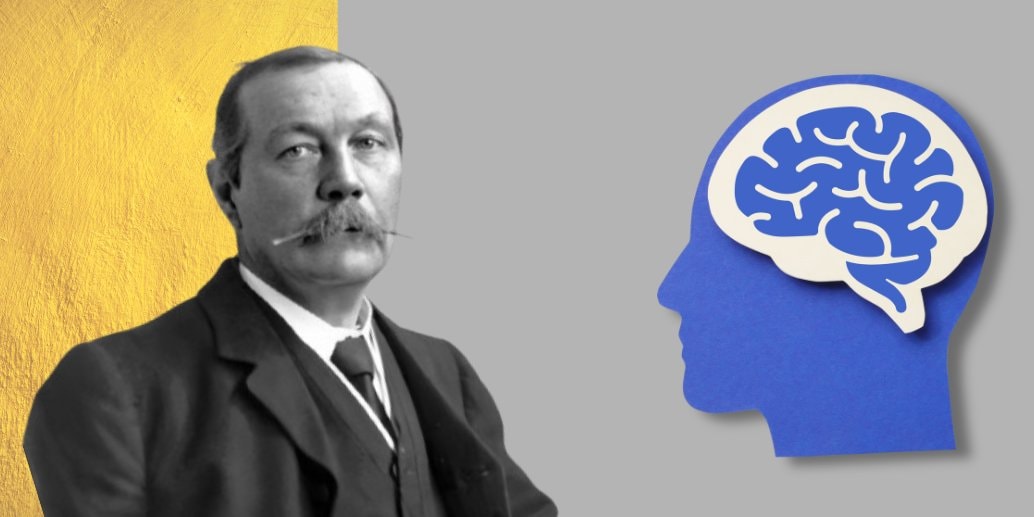
Doyle creates in Holmes a prototype of the algorithmic mind. Holmes famously compares the human brain to an "empty attic." A fool takes in all the lumber of every sort that he comes across, he argues, so the knowledge which might be useful to him gets crowded out.
"It is a mistake to think that that little room has elastic walls and can distend to any extent," Holmes says. "Depend upon it there comes a time when for every addition of knowledge you forget something that you knew before."
This is early disk management. It is RAM allocation. Holmes deletes the fact that the earth goes around the sun because it doesn't help him solve a murder. He is the first "Quantified Self," optimizing his neural pathways for specific outputs.
This resonates today because we are all attempting the same impossible sort. We are drowning in the "useless lumber" Holmes warned against—doom-scrolling, 24-hour news cycles, infinite notifications. Holmes was the first to realize that to survive an information-rich environment, you have to become ruthless about what you allow into your head. His "neurodivergence" is less a disorder and more a radical adaptation to a data-heavy world.
Real-World Inspirations: The Cost of Seeing
Holmes feels real because he was ghost-written by a real man. Doyle modeled him on Dr. Joseph Bell, his professor at Edinburgh, a man who could diagnose a patient’s life history before they opened their mouth.
Doyle admired Bell, but he also saw the toll. As a physician himself, Doyle spent his life watching men die, grieve, and break. He knew that the ability to see everything—the "curse of knowledge"—was heavy. Writing Holmes allowed Doyle to explore the burden of extreme perception. He understood that you cannot be that open to the world's details without developing some scar tissue.
The Algorithm of Vulnerability
We still read Holmes in 2025 not because he solves the crime, but because he pays the price. The archetype Doyle dismantled—the man who must be unfeeling to be effective—is unfortunately still the default setting for many.
Holmes validates the struggle. He proves that you can be brilliant, you can be necessary, and you can still be barely hanging on. His "brain-attic" theory is no longer just a quirky character trait; it is a survival manual for the digital age. We are all trying to keep the lumber out. We are all trying to find work to stop the mind from tearing itself to pieces.
Sherlock Holmes remains the ultimate testament to the idea that capability and fragility coexist. He is a hero who needs the needle, the work, and the friend to survive the day. And really, who can't relate to that?